Attic Mold Remediation in Escondido, CA
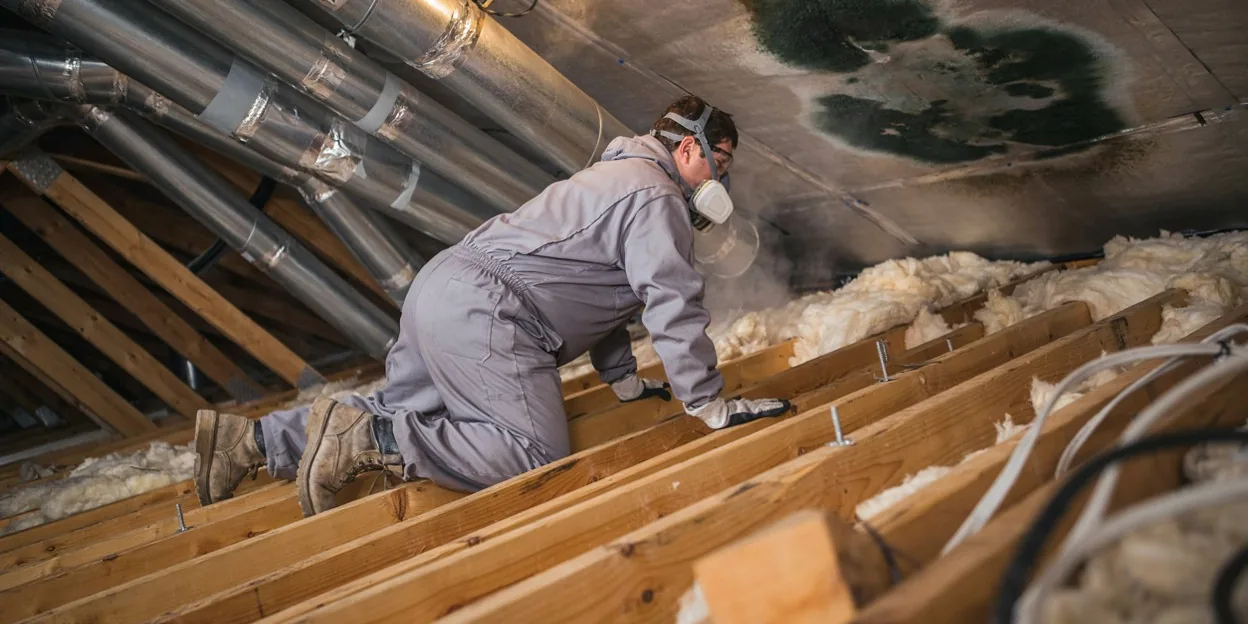
The brown ring on the bedroom ceiling appeared the week of the big January storm, dried to a stain, and then came back darker in February. When you finally climbed into the attic with a flashlight, the plywood above that spot was gray and fuzzy and the insulation under it was matted flat. The concrete tile on the roof looks the same as it did the day you bought the house. This site connects you by phone with an independent local provider who does attic mold remediation in Escondido and across inland North San Diego County.
What the flashlight finds above the stain
The crew goes up with a meter and a camera and reads the sheathing, the rafters, and the top plates around the stain, then follows the water uphill to where it came in. Under concrete tile that is usually a crack or a bare patch in the underlayment, a slipped tile at a valley, or a pipe boot that has baked for thirty summers. Next to a duct, it is a sweating run that drips in August rather than a roof leak at all.
Containment in an attic means sealing the access hatch, covering the rooms below, and running a scrubber at the hatch so what comes loose from the sheathing does not drift down into the bedrooms. On a hot day the crew works early and in short shifts.
Call the roofer first and leave the insulation where it lies
If the ceiling is still wet, the roof is still open, and a roofer needs to find the entry point before the attic work starts; the two trades are scheduled together. Do not pull the matted insulation yourself or sweep the sheathing. Disturbed attic growth falls through the can lights and the hatch into the living space.
Photograph the ceiling stain, and if you can do it safely, the sheathing above it. Note the date the stain first showed and whether it grew after each storm. If the stain sits under a duct run rather than near the roofline, say so on the call, because that changes which trade comes first.
Sheathing cleaned and treated, insulation replaced, roof handed to the roofer
Stained sheathing and rafters are HEPA-vacuumed, cleaned, and treated in place; plywood that has delaminated or reads wet through is cut out and patched, which the crew tells you before they do it. Matted insulation under the stain is bagged and removed, and the ceiling drywall below is metered from above to decide whether it stays.
The roof repair itself is roofer work. A bathroom fan that vents into the attic instead of through the roof is rerouted so the moisture stops. The ceiling drywall below, if it comes out, is mold removal or, if the patch has gone dark, black mold removal. A sweating duct and the cabinet it feeds are HVAC mold cleaning. Patching the ceiling afterward is mold damage repair.
Thirty-year-old underlayment and the atmospheric rivers of 2024
Nearly every Escondido house built from the late 1970s on wears concrete tile over felt or synthetic underlayment, and the tile outlasts the underlayment by decades. The underlayment bakes through thirty summers near 100 degrees, cracks, and sheds water fine in a light rain. Then an atmospheric river arrives. On January 22, 2024, San Diego County recorded its fourth-wettest day since records began, with about 2.7 inches on Escondido over the event, and the February 1 storm that followed put more water on roofs that had not yet dried out. Older ranches with composition shingle and 1920s bungalows with original roof decking show the same pattern with different materials.
Attic work that includes new sheathing or a rerouted fan duct is contractor work under the Contractors State License Board, with a permit through the City of Escondido or San Diego County, and the provider pulls it. California has no mold license, so the provider represents its own training in the cleaning and treatment.
Calling about a stained ceiling in Escondido
Have the address, where the stain is, when it first appeared, and whether you have seen the sheathing above it. Say whether a roofer has already been up. Call (760) 546-5839.